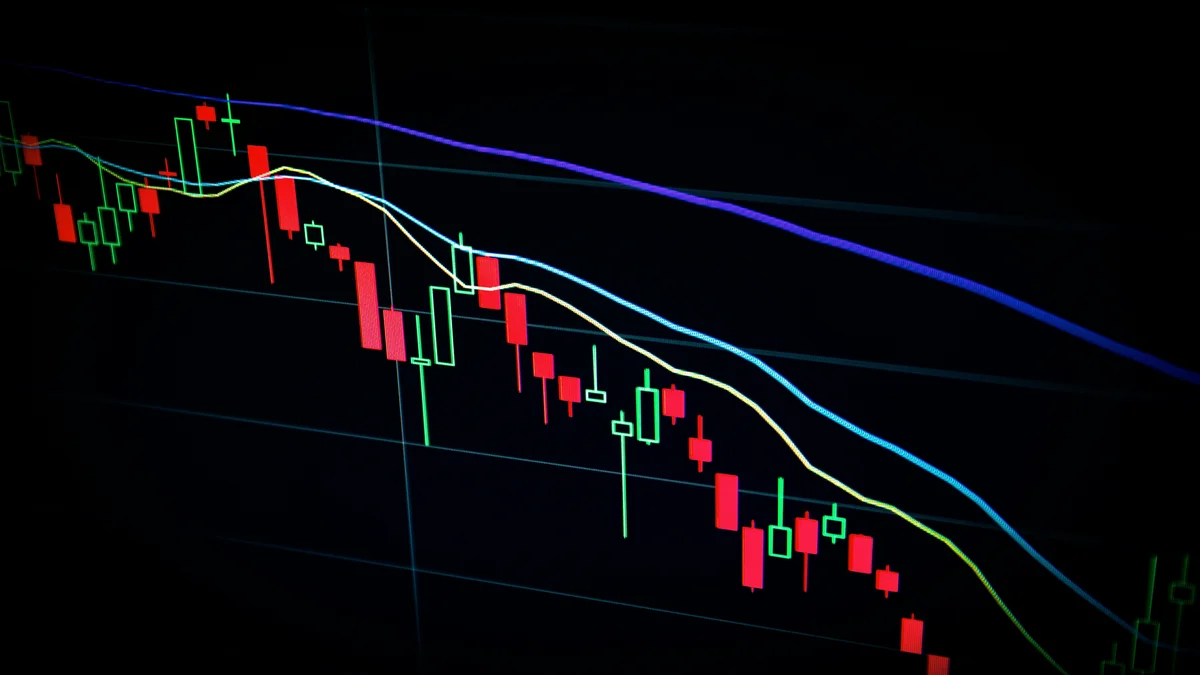
Credit card stocks tumbled across the board on Monday as investors reacted to President Donald Trump's renewed push for a one-year, 10% interest rate cap on credit cards, set to take effect on January 20.
The market selloff reflected mounting concerns about the viability and potential impact of the proposal on financial sector earnings and business models.edition.cnn
Capital One Financial and Synchrony Financial experienced the steepest declines among major credit card issuers, with shares falling approximately 9% to 10% in premarket trading.
American Express dropped 4% to 4.87%, while major banks with substantial credit card operations also faced headwinds: Citigroup fell 3.6% to 4%, JPMorgan Chase declined 2.88% to 3.2%, and Bank of America slipped 2.36% to 2.5%.wsj
Payment processors Visa and Mastercard, which operate networks rather than issue credit directly, saw more modest declines of roughly 1.2% to 2.2%.
Barclays, the United Kingdom-based bank with significant U.S. credit card operations, experienced a 2.5% to 3.5% drop.finance.yahoo
The market reaction intensified after Trump escalated his rhetoric during a Sunday appearance aboard Air Force One. Having announced the rate cap proposal on Truth Social Friday evening, Trump asserted that credit card companies would be "in violation of the law" if they fail to comply with his January 20 deadline.
This language raised questions about whether Trump believed he possessed unilateral executive authority to impose such a cap, despite widespread legal analysis suggesting that congressional action would be required.cnbc
Trump justified the proposal as necessary to address what he characterized as predatory lending practices.
He stated on Truth Social that the American public is being "ripped off" by credit card companies charging rates between 20% and 30%, framing the cap as an affordability measure to combat rising costs of living that have plagued American consumers.cnn
The proposal echoes a campaign commitment Trump made in September 2024 and builds upon bipartisan legislative efforts that have gained traction in Congress.
Senator Bernie Sanders and Senator Josh Hawley jointly introduced legislation in February to impose a temporary 10% cap, while Representative Alexandria Ocasio-Cortez has championed similar proposals in the House. The "10 Percent Credit Card Interest Rate Cap Act" currently sits in the Senate as S.381.congress
However, significant legal and practical obstacles stand in the way of implementation. Legal experts and financial analysts widely agree that Trump likely lacks unilateral executive authority to impose an interest rate cap on credit cards, and that such action would require congressional legislation.
Jefferies analyst John Hecht characterized any cap as "highly unlikely" to become reality, noting that similar proposals have consistently died in Congress despite bipartisan sponsorship.
The banking industry immediately mobilized to oppose the measure. A coalition of five major banking organizations—including the Bank Policy Institute, American Bankers Association, Consumer Bankers Association, Financial Services Forum, and Independent Community Bankers of America—released a joint statement warning of catastrophic consequences.
The groups contended that a 10% cap would "diminish credit availability" and prove "devastating" for millions of American families and small business owners dependent on credit cards, claiming the very measure intended to help consumers would harm them instead.bbc
Industry representatives argued that credit card companies would respond to an interest rate cap by implementing stricter lending standards, reducing credit availability for consumers with lower credit scores or marginal credit histories.
Rather than accepting lower margins on existing customers, lenders would likely restrict access to credit entirely, potentially driving financially vulnerable consumers toward more expensive alternatives such as payday loans, pawn shops, and other non-bank lenders.dailysabah
JPMorgan analyst Vivek Juneja warned that a rate cap "would not address the root of the problem" and would likely push more borrowing away from banks into riskier financial products.
Truist Securities analyst Brian Foran suggested that the credit card business could become unprofitable under a 10% cap, particularly for companies like Synchrony and Bread Financial that rely heavily on credit card lending as their primary business line.dailysabah
The profitability projections reveal the scale of potential impact. Jefferies' analysis indicated that American Express, despite its more premium customer base, could see its net interest margin contract from 9.2% to an estimated 5.7%—a dramatic compression that would require fundamental business restructuring.
For subprime-focused lenders, the math becomes even more severe. Synchrony and Bread Financial, which operate store credit card programs, have the most significant exposure to the cap's effects.
Some analysts noted that credit card companies would likely attempt to compensate for reduced interest income through increased fees and adjusted rewards structures, though such measures would face political headwinds given the affordability focus of the proposal.
Consumer finance companies outside the traditional banking sector positioned themselves to benefit from any cap implementation. Shares of Affirm Holdings, which operates a buy-now-pay-later platform, rose more than 4% in premarket trading, while Block increased roughly 2%, suggesting investors believe alternative lending products would capture displaced demand.
The broader economic implications extend beyond individual company profitability. A legitimate concern within both the banking industry and among economists involves the potential for a credit crunch, particularly affecting middle and lower-income households already struggling with the aftermath of years of elevated inflation.
The Federal Reserve reported that Americans carry $1.1 trillion in credit card debt as of the third quarter of the previous year, increasing $24 billion from the preceding quarter. If access to credit tightens, consumer spending could face headwinds that reverberate through the broader economy.
The proposal marks an unexpected policy reversal for Trump, who during his first term sided with banks against regulatory measures. In April 2025, the Trump administration sought to eliminate a Biden-era regulation capping credit card late fees at $8, claiming the fee limit harmed consumer access to credit.
Trump's administration aligned with banking associations that had contested the rule, and a federal judge ultimately blocked its implementation.edition.cnn
Billionaire investor Bill Ackman acknowledged the goal of reducing credit card rates as "sound and important" but warned that a 10% cap would "inevitably lead to millions of Americans having their cards canceled as credit card companies lose the ability to appropriately price subprime credit risk."
Legislative momentum remains uncertain despite Trump's political capital. Congressional Republicans have historically resisted interest rate caps due to lobbying pressure from the financial services sector. While Senate Republican Roger Marshall indicated conversations with Trump about crafting legislation supporting the cap, and Democratic legislators have long championed such measures, past attempts at rate regulation have stalled.
Raymond James policy analyst Ed Mills noted that "legislative risk remains relatively low, but clearly higher now that the president has called for this action," suggesting that Trump's renewed emphasis could create political pressure even if formal legislation remains uncertain.pbs
The stakes for financial markets and the broader economy hinge on whether Trump's hardline rhetoric translates into actual legislative pursuit. If implemented, the cap would fundamentally restructure an industry that generates substantial revenue from interest rate differentials.
If abandoned as politically unfeasible, the market volatility may prove temporary. Either way, the announcement has reignited debate about the appropriate regulatory framework for consumer credit and the balance between affordable access to credit and financial sector profitability.